BikeWalk NC continues to work with communities across North Carolina to improve bicycle access and safety. Recently, BWNC board member Bruce Tretter helped coordinate the donation of bicycle racks to the Hickory campus of Appalachian State University. The racks were installed by campus maintenance staff on February 26, creating additional space for students and visitors who arrive by bike. Small improvements like these help make bicycling a more practical transportation option and support safer, more bike friendly communities across the state.
BikeWalk NC’s Statement on E-Bikes and Multimodal Safety
Electric assisted bicycles and other electric motorized cycles are transforming personal transportation and offering a popular alternative to automobiles. Some of these vehicles are lower speed electric assisted bicycles as defined under North Carolina law, while others can reach speeds of 30 mph or higher. As their popularity has grown, so have safety concerns and calls for new regulations across the United States.
Under North Carolina law §20-4.01(7a), an electric assisted bicycle is defined as a bicycle with two or three wheels, a seat or saddle, fully operable pedals for human propulsion, and an electric motor of no more than 750 watts. The motor alone cannot propel the bicycle faster than 20 mph on a level surface. Electric assisted bicycles that meet this definition are legally treated the same as conventional bicycles. They are not classified as motor vehicles and do not require a driver’s license, registration, title, or insurance.
Vehicles that exceed the motor power or speed limits, or that do not have operable pedals, are not legally considered electric assisted bicycles in North Carolina. Depending on their configuration as purchased or after modifications, they may instead be classified as motor driven bicycles, mopeds, or motorcycles. These classifications can carry additional requirements such as minimum age limits, licensing, registration, insurance, or specific equipment standards. Because many models look similar, higher speed vehicles are sometimes incorrectly labeled as electric assisted bicycles even though they fall outside the legal definition. It is important that these vehicles are understood and treated separately.
Electric assisted bicycles and other electric motorized cycles represent an important shift in transportation in both urban and rural communities. Thoughtful policy can enhance safety while preserving the benefits these vehicles bring to health, personal mobility, and the economy. Any new regulations should be clear, enforceable, and proportional to risk while maintaining access and encouraging sustainable transportation.
BikeWalk NC believes that the operation of lower speed electric assisted bicycles that meet North Carolina’s legal definition is already adequately covered by existing traffic laws that govern conventional bicycles. If new regulations are considered for higher speed electric motorized cycles, they should not intentionally or unintentionally create barriers to the use of conventional bicycles or electric assisted bicycles that meet the legal definition.
Education and user behavior also play an important role in addressing safety concerns. BikeWalk NC welcomes opportunities to partner with communities and organizations to expand safety education for both bicyclists and drivers through programs such as the Bicycle Safety Quiz, the Friendly Driver Program, and other safety initiatives. BikeWalk NC is currently developing more detailed recommendations and welcomes the opportunity to serve as a resource to state and local officials as these discussions continue.
2026 Multimodal, Bicycle & Pedestrian Planning Grants
The North Carolina Department of Transportation Integrated Mobility Division (IMD) is now accepting applications for the 2026 Multimodal Planning Grant Program.
This program provides state planning funds for comprehensive bicycle, pedestrian, and multimodal planning projects across North Carolina. These grants support local governments working to improve safety, expand transportation options, and strengthen community connectivity.
Regional Planning Organizations (RPOs) and local government agencies are encouraged to apply and share this opportunity broadly with partners who may benefit from planning support. Applications must be submitted online by April 13 at 5 p.m. Award recipients will be notified by June.
Learn more and view the official announcement: Funding Available for Bicycle, Pedestrian and Multimodal Planning
Sponsor the 2026 NC BikeWalk Transportation Summit!
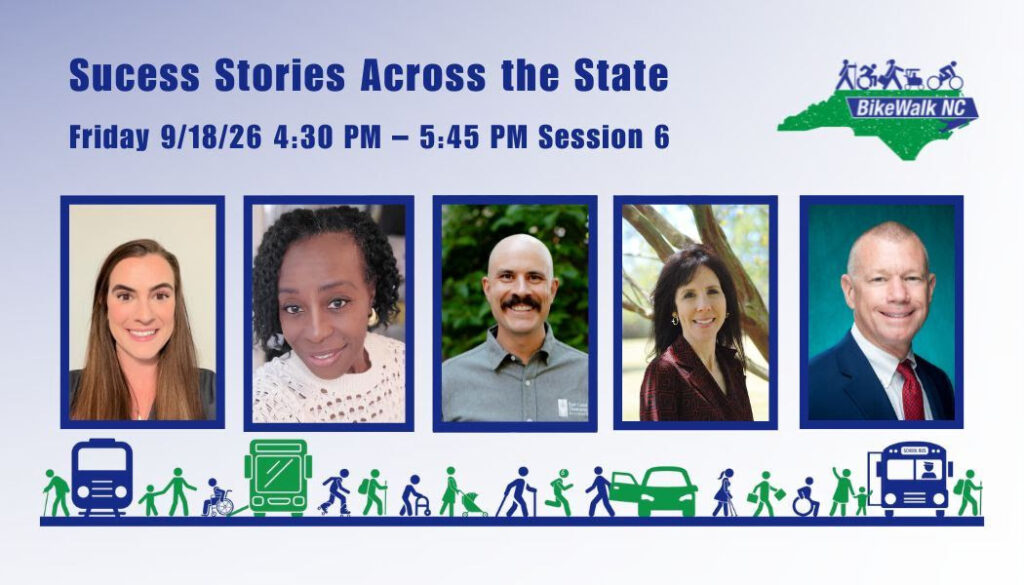
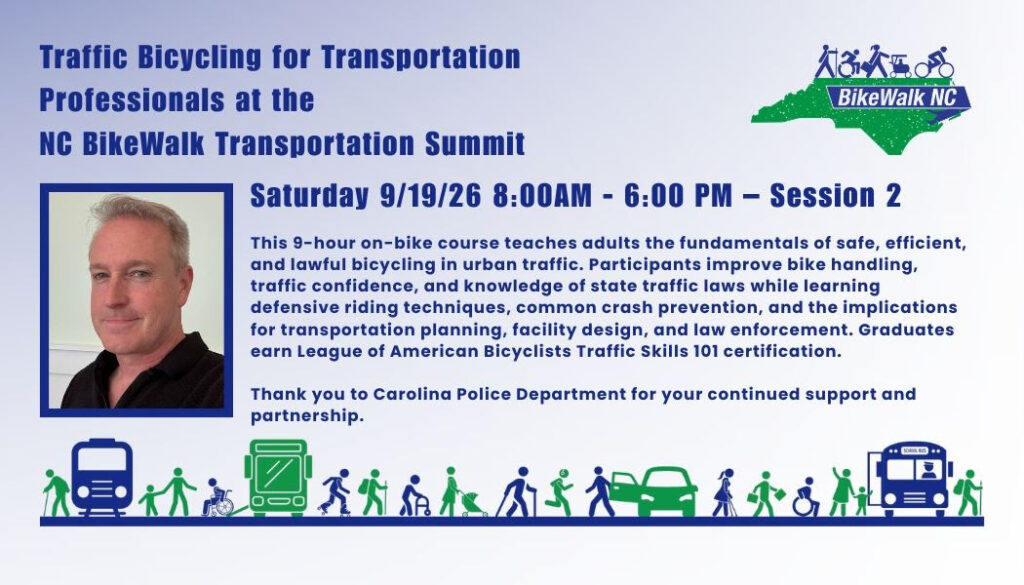
The 2026 NC BikeWalk Transportation Summit will take place September 17 to 19, 2026 in Carolina Beach and will bring together transportation professionals, advocates, public officials and community leaders working to advance safety, health and equity on North Carolina roads. Sponsoring the Summit offers a meaningful opportunity to demonstrate your organization’s commitment to people-centered transportation while connecting with an engaged audience influencing policy planning and practice across the state. Sponsors receive valuable visibility throughout the event and help support hands-on learning, meaningful networking, and the exchange of ideas that attendees carry back to their communities. Sponsorship opportunities are limited and we invite you to review the Sponsorship Package and register through the Summit webpage to support this important gathering.
Friendly Driver Program: 2025 Statewide Growth
BikeWalk NC’s Friendly Driver Program has experienced significant growth over the past four years. From 2022 to 2025, total participation increased by 655 percent, reflecting expanded partnerships, stronger outreach, and increased demand for road safety education across North Carolina.

Designed to help motorists safely share the road with people walking and biking, BikeWalk NC’s Friendly Driver Program continues to build safer, more welcoming streets across North Carolina. In 2025 alone, we delivered 53 presentations and reached 2,242 participants statewide. Each session represents another step toward a culture of awareness, accountability, and mutual respect on our roads.
The Friendly Driver Program is a one-hour, interactive course that covers essential road-sharing topics, including:
- Common crash scenarios and how to prevent them
- The legal rights and responsibilities of drivers, bicyclists, and pedestrians
- Practical strategies to reduce conflicts and improve safety

Throughout 2025, the program continued to grow and connect with a wide range of audiences. We worked with schools and driver’s education programs, municipalities, engineering firms and transportation professionals, YMCA partners, Wake County Safe Routes to School, Winston-Salem/Forsyth County Schools, Durham Public Schools, partners in Chapel Hill, and students at the University of North Carolina at Greensboro. In 2025, we also launched a new design suite for all Friendly Driver materials. The updated visuals improved clarity, accessibility, and consistency across presentations and outreach efforts.

In 2025 our presentations were nearly even split between in-person and virtual participation. In-person sessions allow for direct engagement and interactive discussion, particularly in classrooms and municipal settings. Virtual sessions increase accessibility and allow us to reach professionals, organizations, and partners across the state without geographic or transportation barriers. Maintaining both formats ensures the program remains adaptable and responsive to each community’s needs.
As we look ahead in 2026, we are focused on continuing this growth and bringing the Friendly Driver Program to even more communities across North Carolina.
Interested in hosting or attending a Friendly Driver Program session?
Contact programs@bikewalknc.org